AI search optimization is the practice of making your brand readable, trusted, and quotable by large language models so it gets named inside AI-generated answers rather than buried in a list of blue links. For B2B marketers, it covers two disciplines: Answer Engine Optimization (AEO), which targets direct-answer citations, and Generative Engine Optimization (GEO), which targets inclusion in generated summaries. AI Rank System helps B2B brands become the company ChatGPT, Perplexity, Gemini, and Google AI Overviews name when buyers ask who to work with. This guide explains what changed, why B2B felt it first, and what marketing teams should do about it.
What Is AI Search Optimization?
AI search optimization is the work of getting your brand cited inside answers produced by large language models. When a buyer asks ChatGPT for the best vendors in a category, the model returns a short list of names. That list is the new search results page, and it is far shorter than Google’s. Ten organic positions have effectively become three named companies.
The mechanics differ from traditional search. Google crawls, indexes, and ranks pages. An AI engine retrieves relevant sources, synthesizes them into prose, and cites a handful. Your goal shifts from ranking a URL to being the source the model pulls from and trusts enough to name. Our generative engine optimization guide covers the retrieval mechanics in more depth.
Why B2B Buyers Shifted First
B2B research was always the most tedious kind of search. A procurement lead evaluating a vendor category used to run a dozen queries, open twenty tabs, read comparison posts of uncertain quality, and assemble a shortlist manually. That workflow was expensive in time and produced inconsistent results.
An AI assistant collapses it into one prompt. The buyer asks for the top vendors, gets three names with reasoning, asks a follow-up about pricing or compliance, and has a shortlist in four minutes. For high-consideration purchases with long evaluation cycles, that is a meaningful improvement, which is why adoption in B2B research has moved quickly.
The scale is real. OpenAI has publicly disclosed more than 800 million weekly ChatGPT users, and industry tracking through 2025 put AI Overviews on roughly 13% of US Google searches, a share that has continued climbing. These are directional figures rather than precise measurements, but the direction is not in dispute. Your buyers are inside those numbers.
AEO vs GEO vs SEO: What Each Term Means
SEO optimizes for ranking positions on a search engine results page. The output is a link, and the user clicks through to your site.
AEO (Answer Engine Optimization) optimizes for direct answers. When someone asks a specific question and the engine returns a definitive response, AEO work decides whether your content is the source behind it. This favors clear, extractable, factually structured writing.
GEO (Generative Engine Optimization) optimizes for inclusion in generated summaries and recommendations. This is broader than answering one question. It covers whether the model associates your brand with a category at all, which depends heavily on what other trusted sources say about you.
The three are additive rather than competing. Solid SEO foundations help AI engines find and parse your content. Our SEO vs GEO comparison breaks down where the disciplines overlap and where they diverge.
How AI Engines Decide Who Gets Cited
Four factors carry most of the weight.
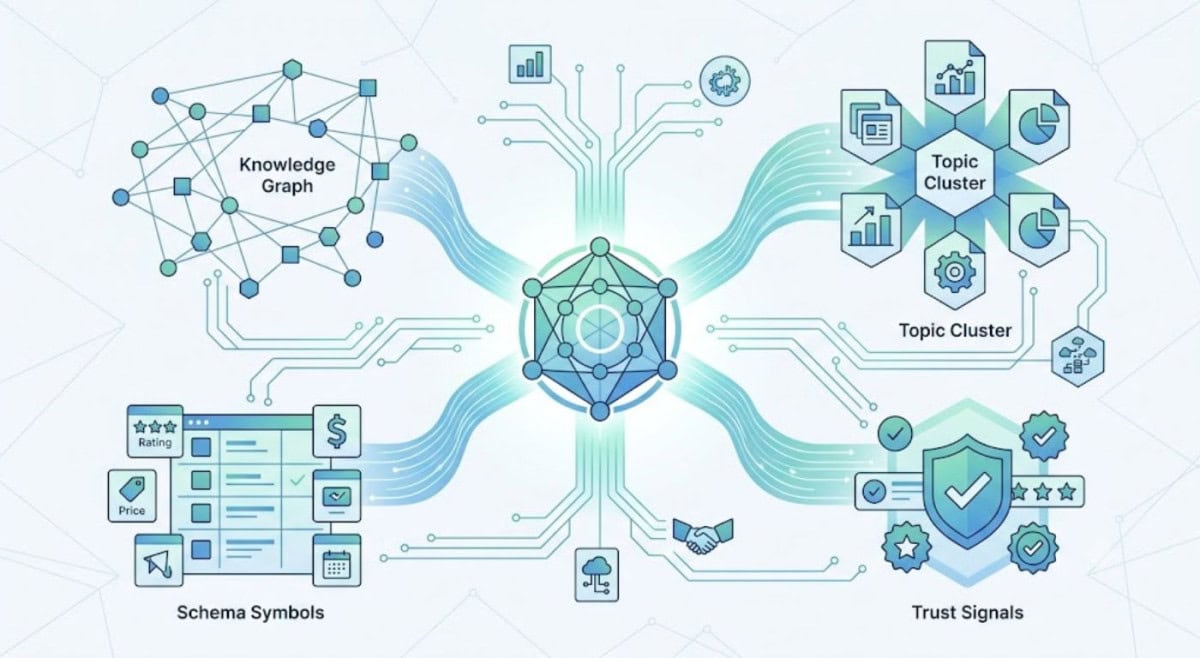
Entity clarity. The model needs to know what your company is, what category it belongs to, and what it does. Fragmented or inconsistent entity data across your site, Wikidata, knowledge panels, and industry directories makes you harder to cite confidently.
Extractable structure. Content written as marketing prose is difficult to quote. Content written as direct claims with clear supporting detail is easy to quote. Question-and-answer formatting, defined terms, and specific figures all improve extraction.
Third-party corroboration. Models weight what independent sources say about you more heavily than what you say about yourself. Mentions in trade publications, directories, review platforms, and comparison content build the corroboration layer.
Category consistency. If different sources describe your company differently, the model has no stable association to draw on. Consistency across every place your brand appears matters more than volume.
What B2B Marketers Should Do First
Audit your current AI visibility. Run the twenty prompts your buyers would actually type across ChatGPT, Gemini, Perplexity, Claude, Google AI Overviews, and Bing Copilot. Record where you appear, where competitors appear, and where nobody does. That last category is your fastest opportunity.
Fix entity data before writing content. New content built on inconsistent entity data underperforms. Align your schema markup, knowledge panel, Wikidata entry, and directory listings first.
Rewrite your highest-value pages into answer format. Take your top ten commercial pages and restructure them so each opens with a direct answer to the question it targets, then supports that answer with specifics.
Build the corroboration layer. Pursue mentions in the publications and directories that cover your category. This is slower than content work and matters more.
Measure citations, not rankings. Position tracking will not tell you whether an AI engine named you. You need a different measurement approach, covered below.
How to Measure AI Search Performance
Traditional analytics miss most of this channel. A buyer who asks ChatGPT for vendor recommendations, sees your name, and later types your brand into a browser shows up in your analytics as direct traffic with no attribution to the AI conversation that produced it.
Useful metrics for AI search work include citation frequency across each platform, share of model against named competitors, the specific prompts you win versus lose, and branded search volume as a lagging indicator of AI-driven discovery. Track these monthly rather than daily, since AI engines update their retrieval and training on slower cycles than Google’s index.
Mistakes B2B Teams Make Early
The most common error is treating AI search as a content volume problem. Publishing forty thin posts targeting AI-related keywords does not build citations. Models cite sources that are clear and corroborated, not sources that are numerous.
The second is optimizing for one platform. ChatGPT, Perplexity, and Google AI Overviews weight sources differently. Work tuned only for one leaves the others unaddressed.
The third is abandoning SEO. AI engines still rely on crawlable, well-structured web content. Teams that cut SEO investment to fund AI search work usually damage both.

Frequently Asked Questions
What is AI search optimization?
AI search optimization is the practice of structuring your content, entity data, and third-party mentions so large language models cite your brand inside generated answers. It combines AEO, which targets direct-answer citations, and GEO, which targets inclusion in generated summaries and recommendations.
Is AEO different from GEO?
Yes, though they overlap heavily. AEO focuses on being the source behind a specific direct answer. GEO focuses on being included when a model generates a broader summary or recommendation list. Most engagements address both.
Does AI search optimization replace SEO?
No. AI engines retrieve from crawlable web content, so SEO foundations remain necessary. AEO and GEO are additional layers on top of solid SEO rather than replacements for it.
How long does it take to see results?
Most B2B engagements see citation movement in 60 to 90 days, with fuller visibility on high-intent prompts taking four to six months. Regulated categories such as healthcare and financial services take longer because models apply stricter trust filters before citing sources.
How do I know if AI engines currently cite my brand?
Run your buyers’ actual questions across the major AI platforms and record the results. A structured audit covering twenty to forty prompts across six platforms gives you a reliable baseline and shows which competitors currently hold the citations you want.
Which B2B categories are most affected?
Categories with long evaluation cycles and committee-driven buying feel it first, including SaaS, professional services, healthcare technology, industrial suppliers, and financial services. These are exactly the categories where buyers historically did the most manual research.
Key Takeaways
- AI search optimization gets your brand named inside AI-generated answers rather than ranked in a link list.
- AEO targets direct-answer citations; GEO targets inclusion in generated summaries. Both sit on top of SEO rather than replacing it.
- Citations depend on entity clarity, extractable content structure, third-party corroboration, and consistent category association.
- Fix entity data before producing new content, or the content underperforms.
- Measure citation frequency and share of model, not keyword positions. Standard analytics will under-attribute this channel.
- Most B2B brands have not started, which is why the window is currently open.
Get Your Free AI Visibility Audit
We benchmark your brand across ChatGPT, Gemini, Perplexity, Claude, Google AI Overviews, and Bing Copilot, compare you against your top three competitors, and hand you a written report showing the prompts you are losing and the ones you can win first. Delivered in five days, no credit card required, and yours to keep either way. Request your free AI visibility audit or book a strategy call.